인터벌 러닝 입문: 구성과 페이스 잡는 법
Interval running basics: structure and pacing
이 글은 일반적인 운동 정보이며 의료 조언이 아닙니다. 심장·호흡기·관절 질환이 있거나, 임신 중이거나, 오랫동안 운동을 쉬었거나, 약을 복용 중이라면 시작 전에 의사나 자격 있는 운동 전문가와 상의하세요. 예시 계획은 설명용이며 모든 사람에게 맞지 않습니다.
인터벌 러닝이 무엇이고 왜 쓰는가
인터벌 러닝은 빠르게 달리는 작업 구간과 느리게 달리거나 걷는 회복 구간을 정해진 횟수만큼 번갈아 하는 훈련입니다. 한 번에 이어서 유지하기 어려운 강도를 짧게 쪼개 반복하기 때문에, 같은 시간 안에 더 높은 강도를 경험할 수 있습니다. 반면 강도가 높아지는 만큼 근육과 관절에 걸리는 부담도 커서, 입문자에게는 "얼마나 빠르게"보다 "얼마나 안전하게 반복하는가"가 먼저입니다.
세계보건기구(WHO)는 성인에게 주당 150~300분의 중강도 유산소 활동, 또는 75~150분의 고강도 활동, 또는 그에 상응하는 조합을 권고합니다. 근력 운동도 정기적으로 하도록 권합니다. 미국 CDC도 성인 기준으로 중강도 150분 또는 고강도 75분, 그리고 주 2일 이상의 근력 운동을 안내합니다. 인터벌은 이 총량을 채우는 한 가지 방법일 뿐 유일한 방법이 아니며, 편하게 걷거나 달리는 시간도 똑같이 가치가 있습니다.
강도를 정하는 법: 대화 테스트와 RPE
처음 시작하는 사람에게 심박계나 정밀한 페이스는 필수가 아닙니다. CDC는 두 가지 간단한 기준을 제시합니다. 대화 테스트는 중강도에서는 말은 할 수 있지만 노래는 못 하는 정도, 고강도에서는 숨을 쉬기 위해 멈추지 않고는 몇 단어 이상 말하기 어려운 정도로 구분합니다. 주관적 운동강도(RPE)는 0(앉아 있는 정도)에서 10(최대 노력)까지의 척도에서, 중강도는 5~6, 고강도는 7~8에서 시작한다고 설명합니다.
| 구간 | RPE(0~10) | 대화 테스트 | 비고 |
|---|---|---|---|
| 워밍업·쿨다운·회복 | 중강도 이하(5~6보다 낮게) | 문장으로 편하게 대화 가능 | 회복 구간에서 숨이 가라앉지 않으면 걷기로 전환 |
| 작업 구간(입문) | 7 안팎 | 몇 단어씩 끊어 말하는 정도 | 마지막 반복에서도 같은 자세를 유지할 수 있는 강도 |
| 작업 구간(적응 후) | 7~8 | 짧은 단어만 가능 | 짧은 반복(1~3분)에 한정, 회복을 충분히 |
핵심은 첫 반복에서 힘을 다 쓰지 않는 것입니다. 마지막 반복의 속도가 첫 반복과 비슷하다면 강도를 잘 잡은 것이고, 뒤로 갈수록 급격히 느려지면 작업 구간이 너무 빨랐다는 신호입니다. 페이스로 목표를 정하고 싶다면 아래 변환기로 속도(km/h)와 분/킬로미터, 거리별 완주 시간을 오가며 확인할 수 있습니다. 예를 들어 6분/킬로미터는 시속 10km이고 5분/킬로미터는 12km/h입니다.
세션의 뼈대: 워밍업, 반복, 쿨다운
- 워밍업(대략 10분). 걷기와 아주 가벼운 조깅으로 체온을 올립니다. 마지막에 10~20초 정도의 가속 달리기를 두세 번 넣으면 빠른 속도에 몸이 적응합니다. 시간은 개인과 기온에 따라 다르므로 몸이 풀렸다고 느껴질 때까지가 기준입니다.
- 반복 구간. 작업과 회복을 정해진 횟수만큼 반복합니다.
- 쿨다운(5~10분). 걷기로 마무리하며 호흡과 심박을 가라앉힙니다.
워밍업을 건너뛰고 바로 빠르게 달리는 것이 입문자의 대표적인 부상 원인입니다. 시간 계산이 번거롭다면 아래 계산기에 준비 달리기, 반복, 마무리를 넣어 총 운동 시간을 미리 확인하세요.
레벨별 예시 계획
아래는 구성을 이해하기 위한 예시입니다. 숫자는 정답이 아니며, 어느 단계에서든 힘들면 한 단계 전으로 돌아가는 것이 정상입니다.
| 레벨 | 작업 구간 | 회복 | 횟수 | 총 시간(대략) |
|---|---|---|---|---|
| 입문 A | 1분 빠르게 (RPE 7 안팎) | 2분 걷기 | 6회 | 약 33분 |
| 입문 B | 2분 빠르게 | 2분 걷기 또는 아주 느린 조깅 | 5회 | 약 40분 |
| 중급 A | 3분 빠르게 (RPE 7~8) | 2분 조깅 | 5회 | 약 45분 |
| 중급 B(거리형) | 400m 빠르게 | 400m 조깅 | 6회 | 약 45~50분 |
입문 A의 계산은 워밍업 10분 + (1분 + 2분) × 6회 = 18분 + 쿨다운 5분으로 33분입니다. 거리형 중급 B는 페이스에 따라 시간이 달라집니다. 400m를 5분/킬로미터로 달리면 2분, 6분/킬로미터로 달리면 2분 24초가 걸립니다.
진행 요령
- 같은 주에 한 번에 한 가지만 늘립니다. 횟수를 늘리거나 작업 시간을 늘리거나 회복을 줄이는 것 중 하나입니다. 이것은 통용되는 코칭 관행이며 특정 연구의 수치가 아닙니다.
- 2~3주 단위로 몸 상태를 보고, 피로가 누적되면 같은 단계를 유지하거나 한 주를 쉽게 보냅니다.
- 작업 구간이 끝난 뒤 회복이 부족하다고 느끼면 회복 시간을 먼저 늘립니다.
4주 예시 흐름
아래는 처음 인터벌을 시도하는 사람이 부담을 천천히 올리는 한 가지 예시입니다. 모든 주에 같은 틀(워밍업 약 10분, 쿨다운 5~10분)을 유지하고 반복 구간만 바꿉니다.
- 1주차. 1분 빠르게 + 2분 걷기를 4회. 목적은 속도가 아니라 "작업과 회복의 리듬"을 몸에 익히는 것입니다.
- 2주차. 같은 구성을 6회로 늘립니다. 마지막 반복의 자세가 무너지지 않는지 확인하세요.
- 3주차. 작업 구간을 1분 30초로 늘리고 횟수는 5회로 낮춥니다. 한 번에 두 가지를 올리지 않기 위한 조정입니다.
- 4주차. 피로가 쌓였다면 2주차 구성으로 쉬어 가고, 여유가 있다면 2분 작업을 시도합니다.
중간에 감기나 일정 때문에 며칠 쉬었다면 쉬기 전보다 한 단계 아래에서 다시 시작하는 것이 안전합니다. 진행 속도를 정하는 기준은 달력이 아니라 몸 상태입니다.
환경에 따라 조정하기
언덕에서는 같은 페이스를 유지하려 하면 강도가 훨씬 올라가므로, 이럴 때는 페이스 대신 RPE나 대화 테스트로 목표를 바꾸는 것이 현실적입니다. 더운 날과 맞바람이 부는 날에도 마찬가지입니다. 같은 RPE라면 속도가 느려지는 것이 정상입니다. 트랙이나 평탄한 길에서는 거리형 반복이 편하고, 신호등이 많은 도심에서는 시간형 반복이 끊김이 적습니다.
한 주의 구성
인터벌은 한 주에 한두 번이면 충분하고, 강한 날 사이에는 편한 날이나 휴식을 둡니다. 예시는 이렇습니다.
| 요일 | 입문 예시 |
|---|---|
| 화 | 인터벌 (입문 A) |
| 수 | 휴식 또는 가벼운 걷기 |
| 목 | 편한 달리기·걷기 30분, 대화가 되는 강도 |
| 금 | 근력 운동 (CDC 기준 주 2일 이상 중 하루) |
| 토 | 인터벌 (입문 B) 또는 편한 달리기 |
| 일 | 휴식, 필요하면 근력 운동 한 번 더 |
이 정도 구성이면 처음에는 주당 총 운동 시간이 WHO·CDC의 권고량(주 150분 이상)에 못 미칠 수 있습니다. 괜찮습니다. 권고량은 도달 목표이고, 처음부터 채우려 하기보다 몇 주에 걸쳐 편한 활동 시간을 늘려 가는 편이 안전합니다.
안전 수칙과 멈춰야 할 신호
- 가슴 통증이나 압박감, 팔·턱으로 퍼지는 통증, 심한 어지러움, 실신할 것 같은 느낌, 평소와 다른 심한 숨 가쁨, 불규칙한 심장 박동이 있으면 즉시 멈추고 쉬세요. 증상이 계속되면 응급 의료 도움을 받으세요.
- 무릎, 정강이, 아킬레스건, 발바닥에 날카롭거나 점점 심해지는 통증이 있으면 인터벌을 중단하고 회복시키세요. 단순한 근육통(뻐근함)과 관절·뼈의 날카로운 통증은 다릅니다.
- 더위·습도가 높은 날은 강도를 낮추고 수분을 챙기세요. 어둡거나 미끄러운 노면에서는 빠르게 달리지 마세요.
- 감기·발열이 있을 때, 잠을 거의 못 잤을 때는 인터벌을 미루세요.
- 운동을 오래 쉬었거나 만성 질환이 있다면 시작 전에 의사와 상담하세요.
회복이 훈련의 절반이다
인터벌은 강도가 높은 만큼 회복에 쓰는 시간도 계획의 일부입니다. 세션 다음 날 가볍게 걷거나 쉬어 주고, 다리가 계속 무겁거나 안정 시 맥박이 평소보다 높게 느껴지면 다음 인터벌을 미루는 것이 이득입니다. 수면 부족, 스트레스, 더위가 겹친 날의 같은 훈련은 같은 강도로 느껴지지 않습니다. 계획표대로 하는 것보다 오늘의 몸 상태에 맞춰 줄이는 용기가 장기적으로 더 많이 달리게 해 줍니다. 특히 입문 몇 주 동안은 "조금 더 할 수 있었는데" 하고 끝내는 것이 적당합니다. 다음 세션을 기대하게 만드는 마무리가 꾸준함을 만듭니다.
자주 하는 실수
- 첫 반복이 가장 빠름. 의욕이 높은 첫 반복에서 힘을 쓰면 마지막에 무너집니다. 첫 반복은 목표보다 살짝 느리게 시작하세요.
- 회복 구간을 달리기로 이어 감. 회복이 너무 빠르면 다음 반복의 질이 떨어지고 결국 이도 저도 아닌 중간 강도가 됩니다.
- 매주 신기록 도전. 모든 세션을 전력으로 하면 회복이 쌓이지 않습니다.
- GPS 순간 속도에 일희일비. 순간 페이스는 오차로 크게 흔들립니다. 몇 초 평균으로 판단하세요.
- 수면·식사 무시. 인터벌의 효과는 운동 중이 아니라 회복 중에 쌓입니다.
- 신발과 노면. 닳은 러닝화로 단단한 노면에서 반복하면 부담이 큽니다.
IntervalRunner로 이 구성을 실행하기
SETLOG가 만든 IntervalRunner는 위의 구성을 시간·거리·심박 존으로 입력해 두고, 목표 페이스에서 벗어나면 음성·효과음·햅틱으로 알려 주는 코치 앱입니다. 시계가 있으면 측정은 Apple Watch가 맡고 iPhone은 화면과 음성을 담당하며, iPhone 단독 실행도 됩니다. 앱 소개 기준으로 이 글의 예시처럼 400m 반복이나 존 2 러닝을 프리셋으로 시작할 수 있습니다. 목표 범위 안에 있을 때만 시간을 세는 방식을 고를 수도 있습니다.
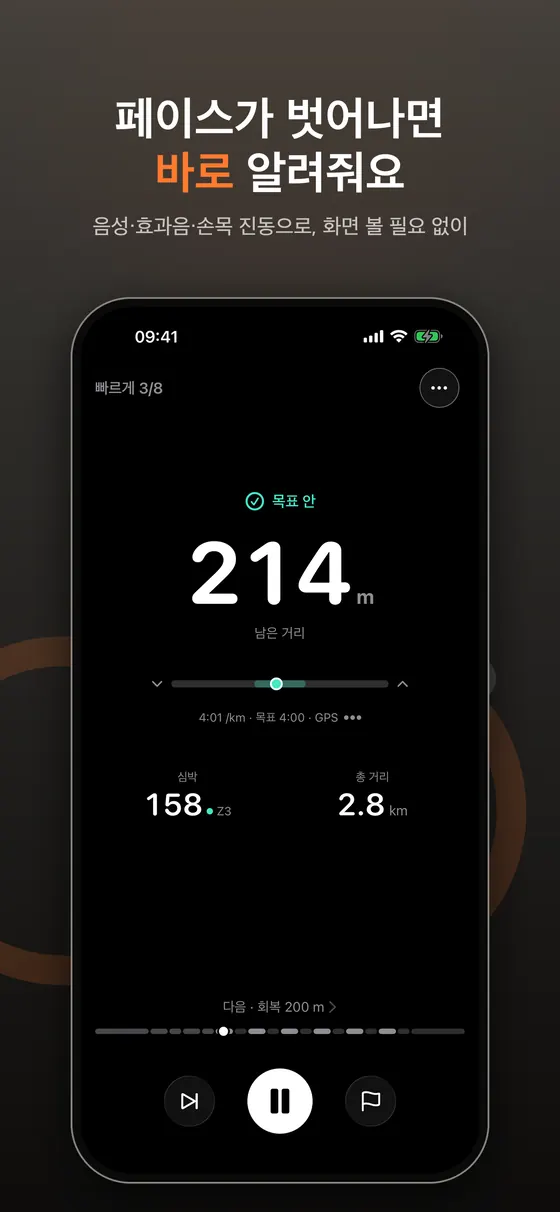
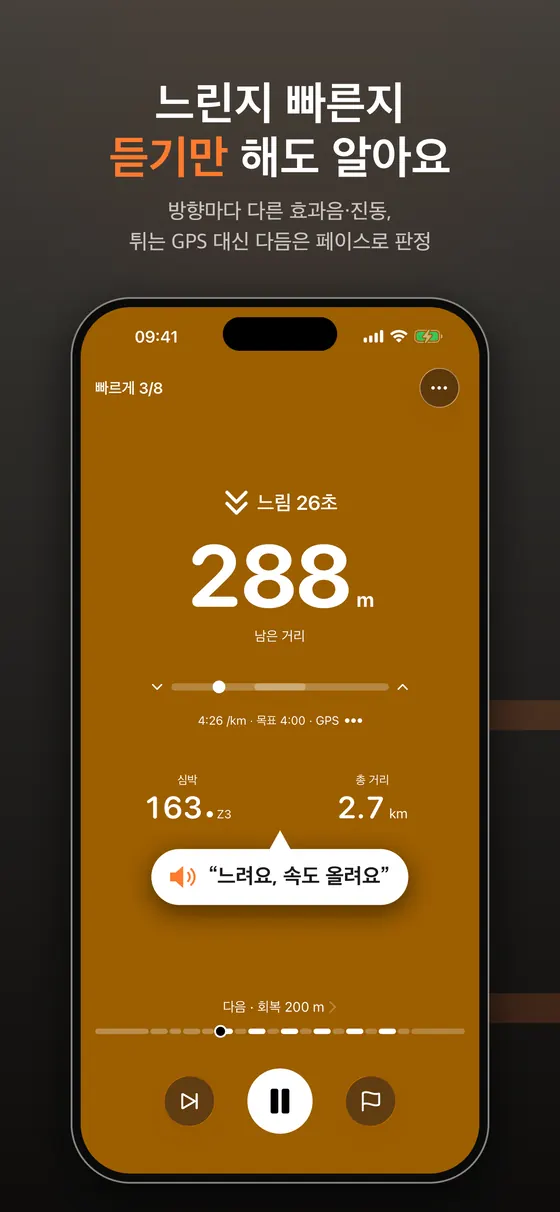
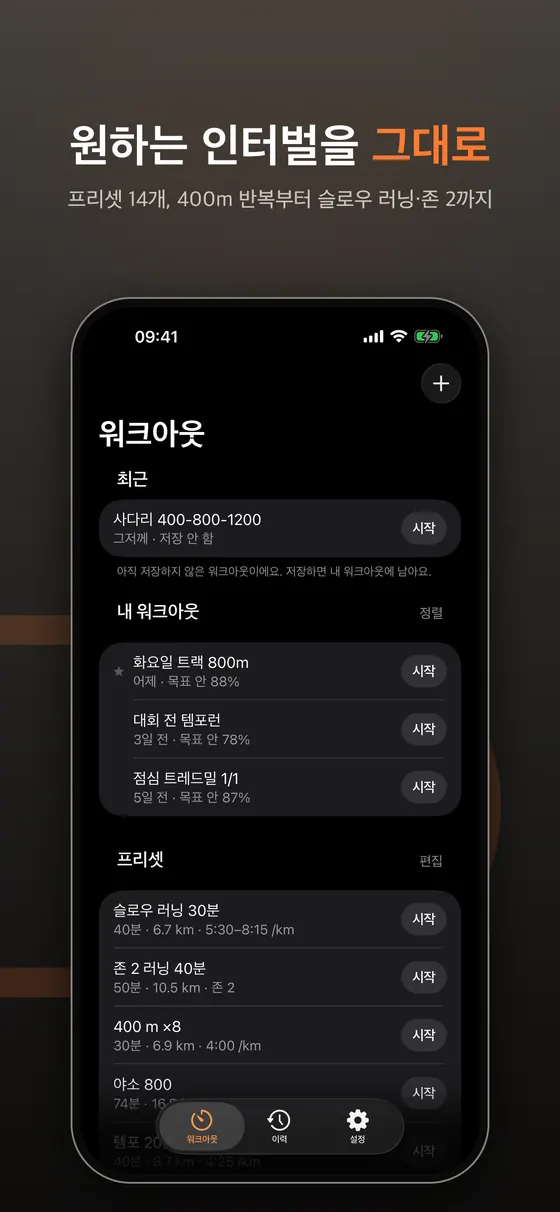
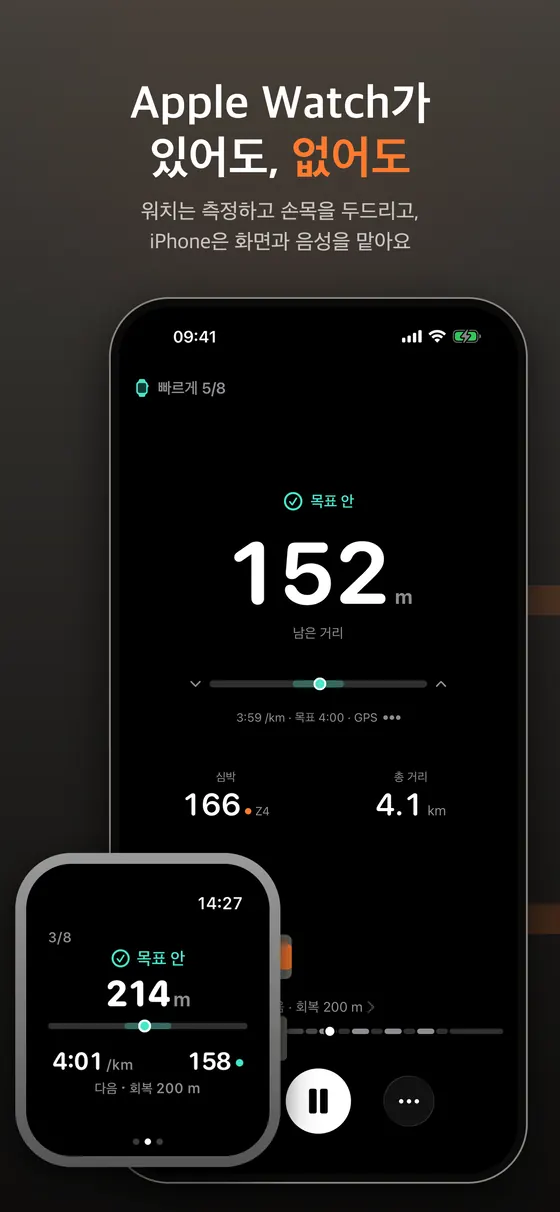
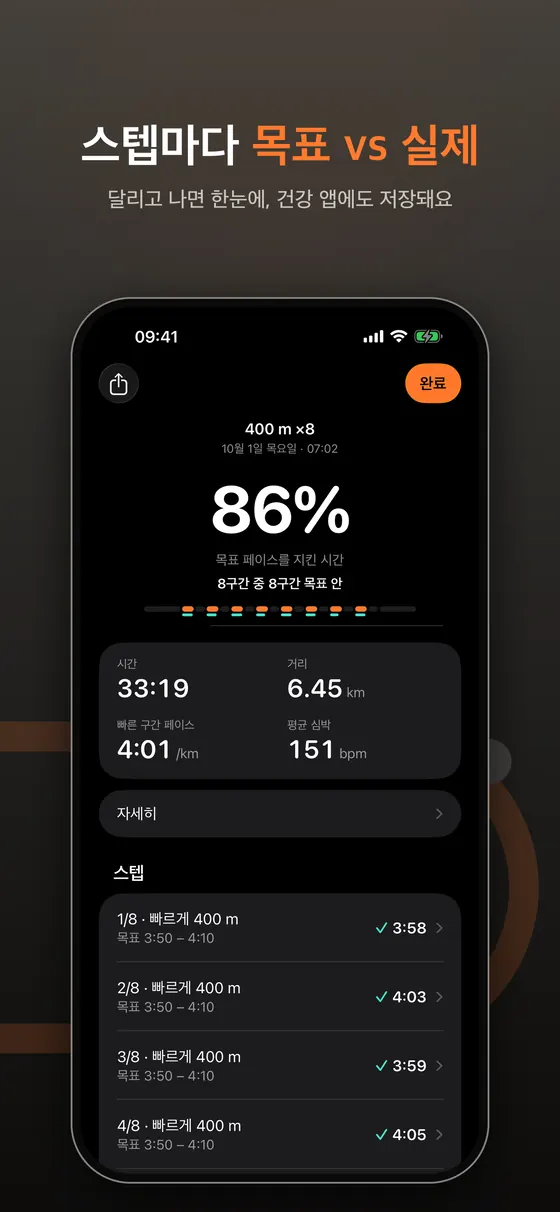
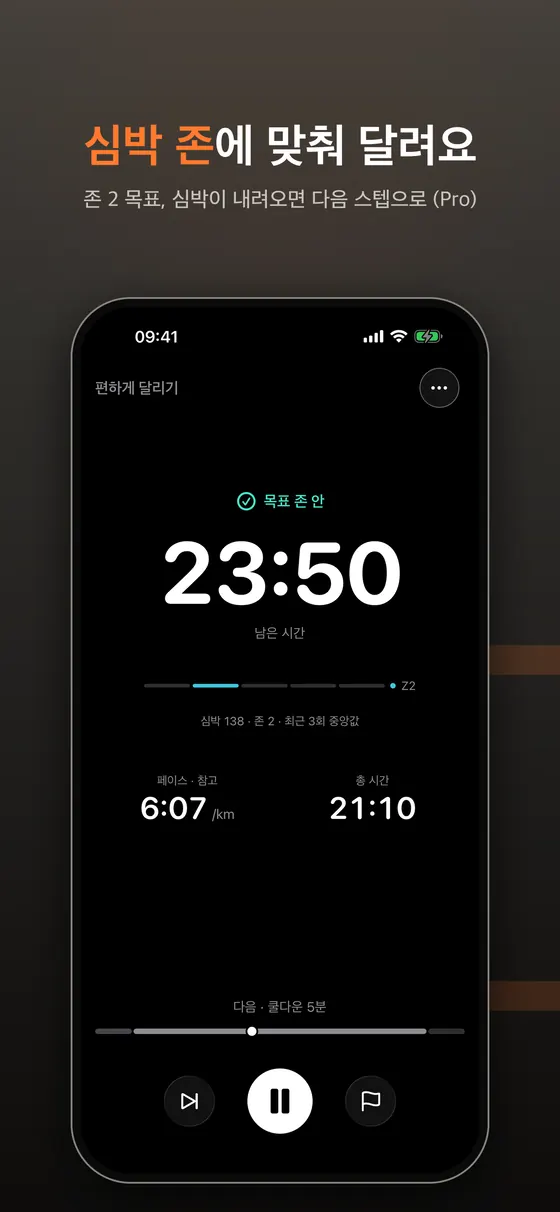
한계도 있습니다. 앱은 iPhone·Apple Watch 중심이며, Android 버전의 지원 범위는 Google Play 설명을 확인해야 합니다. 스토어 스크린샷에는 심박이 내려오면 다음 스텝으로 넘어가는 기능에 Pro 표기가 붙어 있듯, 일부 기능은 구독 대상입니다. 앱은 훈련 계획을 대신 짜 주지 않고, 건강 상태를 판단하지도 않습니다. 사용법은 IntervalRunner 사용 가이드에서 단계별로 설명합니다. 달리기를 마친 뒤 코스를 영상으로 남기고 싶다면 러닝 영상 가이드를 참고하세요.
이런 분께 맞습니다
- 시계를 보지 않고 소리와 진동으로 페이스를 지키고 싶은 분
- 시간·거리·심박 존 인터벌을 직접 설계하는 분
이런 분께는 맞지 않습니다
- 자동으로 훈련 계획을 받고 싶은 분
- 구독 없이 모든 부가 기능을 쓰고 싶은 분
출처 및 더 읽을거리
- Bull FC et al., World Health Organization 2020 guidelines on physical activity and sedentary behaviour, Br J Sports Med 2020 (https://www.ncbi.nlm.nih.gov/pmc/articles/PMC7719906/)
- CDC, Measuring physical activity intensity (대화 테스트·RPE) (https://www.cdc.gov/physical-activity-basics/measuring/index.html)
- CDC, Adult physical activity recommendations (https://www.cdc.gov/physical-activity-basics/adding-adults/what-counts.html)
- WHO, Physical activity fact sheet (https://www.who.int/news-room/fact-sheets/detail/physical-activity)
- IntervalRunner 사용 가이드 (앱 기능은 프로젝트 문서와 앱스토어 설명 기준)
자주 묻는 질문
인터벌 러닝은 일주일에 몇 번이 적당한가요?
입문 단계에서는 한두 번이면 충분하고 강한 날 사이에 편한 날이나 휴식을 두는 것이 일반적입니다. 몸 상태에 따라 조절하세요.
강도를 어떻게 확인하나요?
CDC 기준으로 대화 테스트(중강도는 말은 되지만 노래는 안 됨, 고강도는 몇 단어 이상 어려움)와 0~10 RPE(중강도 5~6, 고강도 7~8 시작)를 쓸 수 있습니다.
주당 운동량 권고는 얼마인가요?
WHO는 성인에게 주 150~300분 중강도 또는 75~150분 고강도 유산소 활동을 권고하고, CDC는 150분 중강도 또는 75분 고강도와 주 2일 이상 근력 운동을 안내합니다.
어떤 증상이 있으면 바로 멈춰야 하나요?
가슴 통증이나 압박감, 팔·턱으로 퍼지는 통증, 심한 어지러움, 실신할 것 같은 느낌, 비정상적인 숨 가쁨, 불규칙한 심장 박동이 있으면 즉시 멈추고 쉬세요. 계속되면 응급 의료 도움을 받으세요.
IntervalRunner를 쓰려면 Apple Watch가 꼭 필요한가요?
아니요. 이 iPhone에서만 실행하는 방식으로 폰 단독으로 쓸 수 있고, 이 경우 손목 햅틱과 시계 측정 심박은 쓸 수 없습니다.
This is general fitness information, not medical advice. If you have heart, lung or joint conditions, are pregnant, have been inactive for a long time or take medication, talk to a doctor or qualified exercise professional before starting. The sample plans are illustrations and will not suit everyone.
What interval running is and why people use it
Interval running alternates fast work intervals with slow running or walking recovery, repeated a set number of times. Because an intensity you cannot hold continuously is split into short pieces, you spend more time at a higher effort in the same session. The flip side is higher load on muscles and joints, so for beginners "how safely can I repeat this" matters more than "how fast".
The World Health Organization recommends that adults do 150 to 300 minutes of moderate-intensity aerobic activity per week, or 75 to 150 minutes of vigorous activity, or an equivalent mix, plus regular muscle-strengthening. The US CDC likewise states 150 minutes moderate or 75 minutes vigorous for adults, with muscle strengthening on at least 2 days a week. Intervals are one way to reach that total, not the only way; easy walking and running count too.
Setting intensity: the talk test and RPE
Beginners do not need a heart-rate monitor or precise pacing. The CDC offers two simple tools. In the talk test, at moderate intensity you can talk but not sing; at vigorous intensity you cannot say more than a few words without pausing for breath. On a perceived exertion scale from 0 (sitting) to 10 (maximal effort), moderate intensity is 5 or 6 and vigorous begins at 7 or 8.
| Segment | RPE (0-10) | Talk test | Note |
|---|---|---|---|
| Warm-up, cool-down, recovery | below moderate | full sentences comfortably | If breathing does not settle in recovery, switch to walking |
| Work interval (beginner) | around 7 | a few words at a time | An effort you can repeat with the same form in the last rep |
| Work interval (adapted) | 7 to 8 | only short words | Keep reps short (1 to 3 min) with enough recovery |
The key is not to spend everything on rep one. If your last rep is about as fast as your first, you chose well; if you fade sharply, the work intervals were too fast. If you prefer pace targets, the converter below (Korean UI) translates between km/h, minutes per km and finishing times: enter either side and read the other. For example 6:00 per km is 10 km/h and 5:00 per km is 12 km/h.
Session skeleton
- Warm-up (about 10 minutes). Walking and very easy jogging to raise body temperature, then two or three 10 to 20 second strides. Time varies with the person and the weather; go by feeling warmed up.
- Repeats. Work and recovery for the planned number of reps.
- Cool-down (5 to 10 minutes). Walk to bring breathing and heart rate down.
Skipping the warm-up and starting fast is a classic beginner injury path. To preview total time, enter warm-up, repeats and cool-down in the calculator below (Korean UI: fields for the warm-up run, repeat count, work and rest times, and cool-down).
Sample plans by level
These illustrate structure; the numbers are not answers. Dropping back a step when it feels too hard is normal.
| Level | Work | Recovery | Reps | Total (approx.) |
|---|---|---|---|---|
| Beginner A | 1 min fast (RPE about 7) | 2 min walk | 6 | about 33 min |
| Beginner B | 2 min fast | 2 min walk or very easy jog | 5 | about 40 min |
| Intermediate A | 3 min fast (RPE 7 to 8) | 2 min jog | 5 | about 45 min |
| Intermediate B (distance) | 400 m fast | 400 m jog | 6 | about 45 to 50 min |
Beginner A adds up as 10 min warm-up + (1 + 2 min) x 6 = 18 min + 5 min cool-down = 33 min. Distance-based sessions vary with pace: 400 m takes 2:00 at 5:00 per km and 2:24 at 6:00 per km.
Progression
- Change one thing per week: more reps, longer work, or shorter recovery. This is a common coaching convention, not a figure from a specific study.
- Reassess every two to three weeks; if fatigue builds, hold the level or take an easier week.
- If recovery feels short, lengthen it before adding anything else.
A four-week example
One way for a first-timer to raise the load slowly. Keep the same frame every week (warm-up about 10 minutes, cool-down 5 to 10 minutes) and change only the repeats.
- Week 1. 1 min fast + 2 min walk, 4 times. The goal is learning the work/recovery rhythm, not speed.
- Week 2. The same, 6 times. Check that your form holds in the last rep.
- Week 3. Lengthen work to 1 min 30 s and drop to 5 reps, so you are not raising two things at once.
- Week 4. If tired, repeat week 2 as a lighter week; if fresh, try 2-minute work intervals.
If a cold or a busy schedule keeps you out for several days, restart one step below where you stopped. The calendar does not set the pace; your body does.
Adjusting for conditions
On hills, holding the same pace sharply raises the effort, so target RPE or the talk test instead of pace. The same goes for hot days and headwinds: at equal RPE a slower speed is normal. Distance-based reps are convenient on a track or flat path; time-based reps flow better in a city with many traffic lights.
Structuring the week
One or two interval sessions a week is enough, with easy days or rest between hard ones. A beginner example:
| Day | Beginner example |
|---|---|
| Tue | Intervals (Beginner A) |
| Wed | Rest or easy walk |
| Thu | 30 min easy run/walk at a conversational effort |
| Fri | Strength work (one of the 2+ days the CDC advises) |
| Sat | Intervals (Beginner B) or easy run |
| Sun | Rest, or a second strength session |
At first this may fall short of the WHO and CDC target of 150 minutes a week. That is fine: the target is something to build toward over weeks, not to hit on day one.
Safety and when to stop
- Stop and rest at once for chest pain or pressure, pain spreading to the arm or jaw, severe dizziness, feeling faint, unusual shortness of breath or an irregular heartbeat. If it persists, seek emergency care.
- Sharp or worsening pain in the knee, shin, Achilles tendon or foot means stop intervals and let it recover. Ordinary muscle soreness differs from sharp joint or bone pain.
- In heat and humidity lower the intensity and drink; never run fast on dark or slippery ground.
- Postpone intervals when you have a fever or a cold, or after very little sleep.
- If you have been inactive or have a chronic condition, see a doctor before starting.
Recovery is half of training
Because intervals are demanding, time for recovery is part of the plan. Walk easily or rest the day after, and if your legs stay heavy or your resting pulse feels higher than usual, postponing the next session pays off. The same workout does not feel the same after poor sleep, stress and heat. Having the nerve to cut back to match today's body makes you run more over the long run than following the chart. During the first few weeks especially, finish feeling you could have done a bit more; an ending that makes you look forward to the next session builds consistency.
Common mistakes
- Fastest rep first. Eager first reps lead to a collapse at the end. Start slightly under target.
- Running the recovery. Recovery that is too quick degrades the next rep and everything turns into medium effort.
- All-out every session. Recovery never accumulates.
- Chasing instant GPS pace. It jumps around; judge by a few-second average.
- Ignoring sleep and food. Gains arrive during recovery, not during the session.
- Worn shoes on hard ground. That adds load you do not need.
Running this structure with IntervalRunner
IntervalRunner, made by SETLOG, lets you enter a structure like the ones above by time, distance or heart-rate zone and alerts you with voice, tones and haptics when you drift off target pace. With a watch, the Apple Watch measures and the iPhone handles screen and voice; iPhone-only mode also works. Per the app description you can start from presets such as 400 m repeats or zone 2 running, and choose to count time only while you are inside the target range.
Limits: the app centers on iPhone and Apple Watch, and the scope of the Android version should be checked on its Google Play listing. Some features are subscription-only; the store screenshot shows a Pro label on moving to the next step when heart rate drops. It does not write a training plan or judge your health. Step-by-step usage is in the IntervalRunner guide; to turn a finished run into a video see the running replay video guide.
A good fit
- You want to hold pace by sound and vibration instead of staring at a watch
- You design your own time, distance or zone intervals
Not a fit
- You want an automatic training plan
- You want every extra with no subscription
Sources and further reading
- Bull FC et al., World Health Organization 2020 guidelines on physical activity and sedentary behaviour, Br J Sports Med 2020 (https://www.ncbi.nlm.nih.gov/pmc/articles/PMC7719906/)
- CDC, Measuring physical activity intensity (talk test, RPE) (https://www.cdc.gov/physical-activity-basics/measuring/index.html)
- CDC, Adult physical activity recommendations (https://www.cdc.gov/physical-activity-basics/adding-adults/what-counts.html)
- WHO, Physical activity fact sheet (https://www.who.int/news-room/fact-sheets/detail/physical-activity)
- IntervalRunner guide (app features per project documentation and the App Store description)
FAQ
How many interval sessions a week?
One or two is usually enough at the start, with easy days or rest between hard ones. Adjust to how you feel.
How can I check intensity?
Use the CDC benchmarks: the talk test (moderate: can talk but not sing; vigorous: only a few words) and a 0 to 10 RPE (moderate 5 to 6, vigorous from 7 to 8).
What weekly activity is recommended?
WHO: 150 to 300 min moderate or 75 to 150 min vigorous aerobic activity for adults. CDC: 150 min moderate or 75 min vigorous plus muscle strengthening on 2 or more days.
When should I stop immediately?
Chest pain or pressure, pain spreading to arm or jaw, severe dizziness, feeling faint, unusual breathlessness or an irregular heartbeat: stop and rest, and seek emergency care if it continues.
Do I need an Apple Watch for IntervalRunner?
No. iPhone-only mode works, but wrist haptics and watch-measured heart rate are unavailable.